
Heroic Puebla de Zaragoza, or Puebla de los Angeles, is one of the cultural gems of Mexico. Located about 70 miles from Mexico City, Puebla contains more works of art than any other place in Mexico and the Americas and has been declared a World Heritage Site by UNESCO.
Puebla’s Historic Center of the city, which was founded in the 16th century, reflects its rich and turbulent history. Although the downtown area showcases centuries of history, Puebla today is one of the Mexico’s largest cities, (population almost 2 million) and a first-class industrial, commercial and tourism center. This rapidly growing, contemporary city, with its many big, modern buildings, as well as centuries-old haciendas, extends in all directions from the Historic Center. Surrounding it are numerous interesting attractions that make this destination one of the most fascinating in all of Mexico.
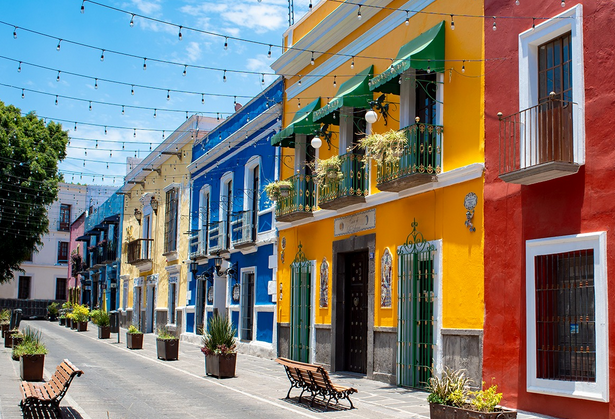
There are numerous plazas, small parks, colonial homes, churches and small streets that make this a pedestrian friendly destination, with numerous cafes, restaurants and shops to found all around the main square. Despite the immense size of the city itself, in the historic center the traveler will find so much to enlighten and entertain within walking distance of the main square. One important distinction that makes Puebla so unique are the many buildings and churches whose facades are completely or partially covered in the famous Spanish talavera tiles.
The zocalo (main plaza), in the heart of the Centro Historico, is a pleasant place to pass an afternoon. Huge laurel and jacaranda trees shade the iron benches frame the playful fountain. Many shops, hotels and restaurants surround the zocalo as well as the main cathedral of Puebla, the Cathedral of the Immaculate Conception. The church takes up one whole side of the zocalo. One of Mexico’s largest churches, completed in 1649, the interior features 14 chapels, an onyx main altar, a beautiful wood inlay choir loft, and colonial religious art. Outside, the fence that surrounds the cathedral has angels all around, guarding the church.
The State of Puebla, of which the city Puebla is capital, is located in the south central portion of the Mexican Republic, and has population of more than 4 million people. Because of its mountainous terrain, and high altitude (higher than 2000 meters (7,800 feet) above sea level) it is hot during the day and very cool, and sometimes very cold at night. Yearly temperatures averages are 70F for daytime and 51F at night.
Puebla occupies an important position in Mexico’s history, as the location for the Battle of Puebla where the local militia was able to defeat the French Army on May the 5th, 1862. This victory is the cause for today’s Cinco de Mayo holiday, which is most enthusiastically celebrated in Puebla. The massive, stone forts of Loreto and Guadalupe that protected the city can still be seen and visited. Of other historic interest is the legend of the China Poblana, who is memorialized all over the city and has a large monument dedicated to her, close to the center of town.
18th century chronicler Miguel de Alcala y Mendiola, inspired by the greatness of Puebla de los Angeles, wrote these lines in honor of the China Poblana:
If the city of angels
Measures you from the heavens,
It will turn you into heaven.
For greater dignity
Your sovereign principles,
Admired for their civility,
have never been equaled.
When the sky is depopulated,
The angels end up in Puebla
Whereas courtiers end up in Heaven.
The Search for the Truth about the Origins of Mole Poblano, and more…
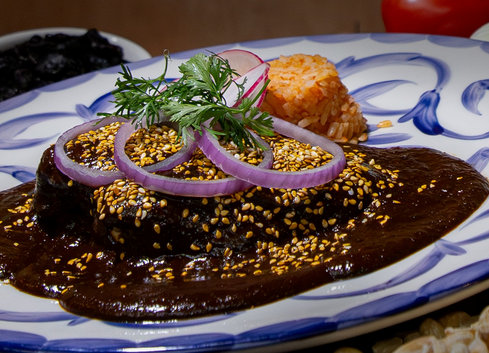
The origin of mole poblano, the thick, rich, chocolate-tinged sauce made so famous in the colonial mountain city of Puebla, Mexico, is still disputed, but generally involves these two versions of the legend:
The first says that 16th Century nuns from the Convent of Santa Rosa in Puebla de los Angeles, upon learning that the Archbishop was coming for a visit, went into a panic because they had nothing to serve him. The nuns started praying desperately and an angel came to inspire them. They began chopping and grinding and roasting, mixing different types of chiles together with spices, day-old bread, nuts, a little chocolate and approximately 20 other ingredients..
This concoction boiled for hours and was reduced to the thick, sweet, rich and fragrant mole sauce we know today. To serve in the mole, they killed the only meat they had, an old turkey, and the strange sauce was poured over it. The archbishop was more than happy with his banquet and the nuns saved face. Little did they know they were creating the Mexican National dish for holidays and feasts, and that today, millions of people worldwide have at least heard of mole poblano.
The other legend states that mole came from pre-hispanic times and that Aztec king, Moctezuma, thinking the conquistadors were gods, served mole to Cortez at a banquet to receive them. This story probably gained credibility because the word mole comes from the Nahuatl word “milli” which means sauce or “concoction”. Another connection could be that chocolate was widely used in pre-columbian mexico, so people jumped to that conclusion.
Diana Kennedy, the famous cookbook author and television chef, adds a third, less plausible version in her book The Cuisines of Mexico, [Harper & Row:New York] 1972, (p.199-200), “This time it was Fray Pascual who was preparing the banquet at the convent where he (the archbishop) was going to eat. Turkeys were cooking in cazuelas on the fire; as Fray Pascual, scolding his assistants for their untidiness, gathered up al the spices they had been using, and putting them together on a tray, a sudden gust of wind swept across the kitchen and they spilled over the cazuelas.” Thus mixing together such an unheard-of combination of ingredients.
What do the real experts say? “The idea of using chocolate as a flavoring in cooked food would have been horrifying to the Aztecs—just as Christians could not conceive of using communion wine to make, say, coq au vin. In all the pages of Sahagun that deal with Aztec cuisine and with chocolate, there is not a hint that it ever entered into an Aztec dish. Yet, today many food writers and gourmets consider one particular dish, the famous pavo in mole poblano, which contains chocolate, to represent the pinnacle of the Mexican cooking tradition. …the place of origin of the dish and its sauce, the Colonial Puebla de los Angeles; this beautiful city, unlike others in central Mexico, has no Aztec foundations – and neither does the dish, regardless of what food writers may say.” Taken from The True History of Chocolate, Sophie D. Coe and Michael D. Coe [Thames and Hudson: London] 1996 (p. 216-7).
There is no greater expert on pre-hispanic Mesoamerica than Michael Coe and this detective is convinced. Case closed (for now) on the mystery of the origins of mole poblano.
THE OTHER MOLES
No story about mole poblano would be complete without talking a little bit about the other moles. There is a lot of misinformation about mole out there, in general. Most culinary experts agree, there are 6 moles and as Susana Trilling describes in her book, My Search for the Seventh Mole: A story with Recipes from Oaxaca, Mexico, [self-published, 1997], she is looking for that elusive seventh mole. Does she find it? You’ll have to read the book to find out, and the recipes are fantastic, so you can try your own mole at home, if you dare.
All moles are very time consuming, labor intensive and require many ingredients. Some sources state that some moles have as many as 100 ingredients, but that’s an exaggeration. But 30 ingredients is not unheard of, and some mole recipes contain 10 different varieties of chiles alone. Other ingredients include: peanuts, almonds, fried bread, plantains, lard, sugar, bittersweet chocolate, cinnamon, cloves and many more.
Each Mexican woman has her own mole recipe, probably passed down from her mother. Because mole takes so much time to prepare, it is usually made in huge batches, too large for the home blender to handle. Therefore, women take their mole ingredients, all cooked and ready to blend, to large “molinos” or grinders in their neighborhood. The mole is passed through the grinders and comes out smoother than you could get from your home blender. It’s not an unusual site to see women walking home from the molinos with buckets of mole for a fiesta.
And be sure to have plenty of napkins nearby when eating any mole. As you dip your warm, homemade tortilla into the wonderful sauce, you are bound to take some home with you on your shirt, your arms and under your fingernails. Now you know you’re enjoying mole!
OTHER “MUST TRY WHEN IN PUEBLA” TYPICAL DISHES
CHILES EN NOGADA – The name comes from the Spanish word for walnut, “nogal”. There are several excellent recipes for Chiles en Nogada on the internet, if you’re interested in making it. It consists of a large chile poblano stuffed with a mixture of ground beef, walnuts, veggies, sherry or brandy and other ingredients. It is covered with a creamy sauce and topped with pomegranate seeds. This is the meal that was used to celebrate Mexico’s 100 years of Independence because of its colors, the green chile, the while sauce and the red seeds, it pays homage to the Mexican flag. It is a seasonal dish and only served for the several months that the ingredients are fresh. It is suggested that chiles en nogada was born from the French influence from when Austrian Archduke Ferdinand Maxamillian took over Puebla. They were later defeated by the Mexicans in the battle of Cinco de Mayo. Chiles en Nogada can be quite expensive because of the pricey ingredients and large sizeof the chile poblano.
CHALUPAS – The real chalupas are nothing like taco bell’s version! Chalupas are usually served in taco shops or from street vendors. They are small, thick tortillas, usually served in a stack, they come 3 with a red salsa, and 3 with a green salsa. Sometimes you can add a meat topping or a little cheese.
CEMITAS – Cemitas are Puebla’s version of a sandwich. Unlike the popular torta, cemitas are sandwiches made with a different type of roll, a sort of egg bread, with sesame seeds on top. They include a meat of your choice; milanesa (beef steak pounded thin and fried), pierna (pork leg which carnitas is made from also), chicken or sometimes cheese. The most interesting thing about a cemita is the local, green leaves they put on the sandwich instead of lettuce. It is called papalo and has an unusual bitterish flavor that compliments the cemita. Cemitas are very inexpensive and tasty.
ROMPOPE- This creamy, thick liqueur is reminiscent of eggnog, and also contains rum. It too is said to have first been made by the nuns in Puebla! (can this be true?) and the best-selling Mexican brand, Santa Clara, has a picture of nuns on the bottle! What were nuns doing inventing liqueur? Anyway, it is delicious and is also usually drunk around the Christmas holidays.
DULCES (CAMOTES)- Last but certainly not least, no story about Puebla treats would be complete without mentioning the sweets!!! The camote (or sweet potato) candy is unique to Puebla. In fact, Poblano men are referred to as “camotes”. They are everywhere! And they are still made in the traditional way, rolling each candy by hand after it has been cooked and perhaps had a fruit flavor added. And yet again, the camotes are said to have been first made by the nuns of the convent Santa Clara. What was up with the nuns of Puebla and inventing fascinating dishes? (perhaps that’s the next investigation!) There are entire streets dedicated to “dulces” in Puebla. They are amazing, colorful and fun places to shop, with windows full of dozens of different candies, gift baskets of every size and shape, and samples! A perfect gift to take home for friends and family, but make sure to get a basket for yourself too, the dulces are too tempting and Mom’s souvenir basket just might not make it home!
OTHER DISHES YOU MIGHT WANT TO TRY BUT YOU MIGHT NOT!!- Gusanos de maguey, worms from the agave plant, and escamoles, ant larvae that are harvested from the roots of the agave or maguey plant (the one that tequila and mescal come from). These are considered “delicacies” and are served only when in season. Some adventurous types will want to try these; “when in Rome…”
ACCOMMODATIONS
ACTIVITIES & TOURS
RESTAURANTS & BARS
BEAUTY & HEALTH