
Todos Santos is a Baja California Sur oasis on the Pacific Ocean approximately 50 miles north of Cabo San Lucas and 50 miles southwest of La Paz in southern Baja California. Todos Santos is located just south of the Tropic of Cancer.
The climate is delightful with year-round temperatures in the 70’s and 80’s. The rainy season, which can be hot and humid, begins in August and continues through the end of September. The prevailing Pacific winds cool the land while driving cloud formations eastward. Normally these conditions would create a very arid environment. However, the 7,000 foot Sierra de la Laguna mountain range above Todos Santos receives abundant rainfall which flows and filters down to Todos Santos, creating the spectacular oasis that distinguishes the region. Orchards of mangoes, papayas and various vegetables flourish here.
Todos Santos cannot be compared to Cabo, Acapulco, or even La Paz. It is a sleepy little paradise, a charming traditional Mexican town. The town closes by 10:00 p.m. unless there is a dance or a party, in which case…who knows. One fiesta the town will stay up for is the Festival de la Virgin de Pilar, a sort of founder’s day on October 12th. The town is probably most famous for it’s artists. You’ll find many prominent artists and their art galleries here in town, sort of a “Carmel in Baja“. There are several fine and justifiably famous restaurants. You’ll find high-end lodging as well the less expensive.
Perhaps not as progressive and fast moving as other Mexican resorts, Todos Santos is an authentic Mexican village. The people are happy, kind and gentle. Many current families’ ancestors first settled here in the 1700’s. The lifestyle here is simple and quiet. Recently an influx of foreigners (mainly American) have arrived but seem to stay within the Todos Santos vibe.
The nearby settlements of Pescadero and Cerritos are flourishing with farms, restaurants, hotels, campgrounds and all the beach activities this area is famous for; surfing, horseback riding, mountain biking and more.
Todos Santos may not offer sophistication or affluence that can be measured in gold or silver, but it does offer beauty, heart and peace, riches not easily found in current times. A perfect place to relax and unwind.
Todos Santos History
The history of Todos Santos dates back to 1723, when the Jesuits came to establish a regional outpost (visita) Mission.
They discovered Pericu, Cochimi, and Guaycura Indians living in the mountain areas surrounding what is now Todos Santos. Some of the ranches as we know today, such as Guayabitas, were once Indian settlements. One of the purposes of the establishment of the mission here was to convert the natives to the Catholic lifestyle. The Indians were entranced by the Holy Saints days, along with the special adornments they were given to wear, but they rebelled at many changes, including monogamy. They also did not like to wear clothes to church. Soon rebellion and epidemics destroyed the inter-cultural relationships and the Jesuit effort at conversion failed, though the pueblo continued to prosper.
A major reason for this prosperity was the abundant water and fertile soil that the newcomers found in this special oasis. Sugar cane, corn and various other vegetables supported daily life.
Although the original missionaries were chased from the area, others stayed and continued to develop the various forms of agriculture. By the late 1800’s this was a major sugar cane producing area, reportedly exporting tons of sugar cane candies to the mainland. There were five “molinos” or sugar cane processing plants in the area, as evidenced by the still standing large brick chimneys dotting the local landscape.
The war of 1847 briefly interrupted the tranquility of life in Todos Santos. More devastating was the 1910 Mexican Revolution, in which Todos Santos and Pescadero became major battlegrounds.
Illustrious figures came into historical focus during this period, including General Dominguez Cota, whose hacienda home still stands in San Ignacio, General Antonio Meliton Albanez Dominguez and General Augustine Olochea Aviles who later served two terms as governor of the territory. One of the most famous, Dionisia Villarino “La Coronela” was an exemplary woman of valor as she organized a strong women’s auxiliary group which played a major role in espionage.
After the war, life returned to normal, and Todos Santos boomed. Many of the homes in the historic district were built or remodeled during the period. The sugar cane industry flourished until a great drought befell the area in the early 1950’s. The underground water table dried up; in 1974 there was only one molino left in operation, which is now at the former site of the El Molino Trailer Park.
The pueblo was “re-discovered” in 1984 when the road from Todos Santos to Cabo San Lucas was paved. (Earlier tourists headed for Cabo took the route along the East Cape). This discovery was by artists and other creative people who savored the tranquil lifestyle of this authentic Mexican village. This time, however, instead of trying to convert the natives to the imported lifestyle, the foreigners worked hard to blend with their adopted culture.
Historical Buildings and Sites
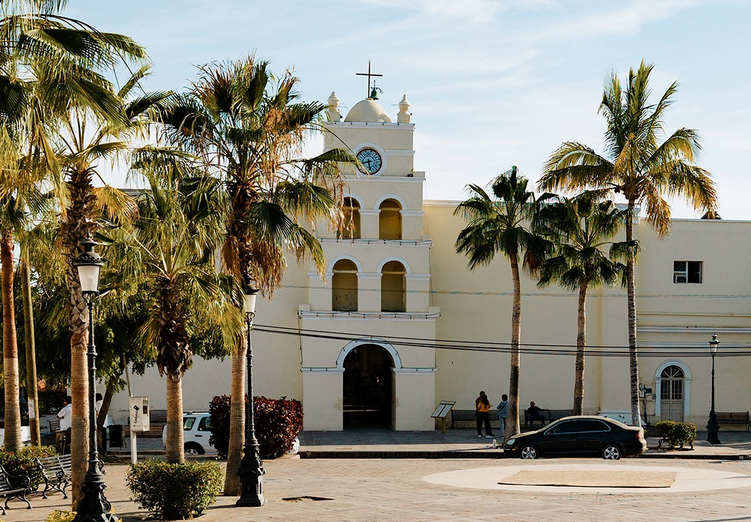
Iglesia de Nuestra Senora de La Paz. The original Catholic Church built in 1747 and expanded over the years The original church comprised what is currently the vestibule. Excellent examples of early California religious art.
If you like cemeteries, don’t miss the one up the road from the corner of Ocampo and Rangel. Many graves date back to the early 1800’s and as you can see; some of the very oldest ones are not dated. The new cemetery is at the far end of Calle Obregon. Very colorful.
As you roam around town, you will see many “Molinos” or tall chimneys, majestic monuments to the great sugar cane producing era of 1850 to 1950.
ACCOMMODATIONS

ACTIVITIES & TOURS
RESTAURANTS & BARS
REAL ESTATE
SHOPPING