|
The Legend of Popocatepetl and Iztaccihuatl
On a clear day, the towering white peaks of the
legendary Popocatepetl and Iztaccihuatl volcanoes can
be seen from the great metropolis of Mexico City.
Rising beyond 17,000 feet in elevation, these two
majestic mountains offer the viewer a breathtaking
sight. Snowcapped year round, the well-known landmarks
have captured people's imaginations throughout the
ages. Located just 45 miles southeast of the nation's
capital, Popo and Izta, as many affectionately call
these two volcanoes, share a story that reaches back
into the mists of time.
Geographically, these two glacier-iced volcanoes
represent the second and third highest mountains in
Mexico. The name Iztaccihuatl in the indigenous
Nahuatl language means "White Woman" and the mountain
actually includes four peaks, the tallest of which
reaches 17,158 feet. Many see her silhouette as
resembling that of a sleeping woman, complete with
head, chest, knees and feet. Iztaccihuatl is an
extinct volcano and is a popular destination for
adventurous mountaineers and hikers.
 |
|
The sleeping woman - Artist Jesus Helguera | |
Popocatepetl is the taller of the two mountains,
reaching an incredible 17,802 feet in height.
Popocatepetl and Iztaccihuatl are connected by a high
mountain pass known as the Paso de Cortes.
Popocatepetl is still active with the volcano having
spewed smoke and ash as recently as 2001. In the
Nauhuatl language Popocatepetl means "Smoking Mountain"
and as we shall soon see, was aptly named.
In Aztec mythology, the volcanoes were once humans who
were deeply in love. This legend features two
star-crossed lovers, the young brave warrior
Popocatepetl and the beautiful princess Iztaccihuatl.
The father of Iztaccihuatl, a mighty ruler, placed a
demanding condition upon Popocatepetl before he could
take Iztaccihuatl as his bride. His mandate required
that Popocatepetl first engage in battle against the
tribe's enemy and return victorious. Variations of the
legend include the added stipulation that Popocatepetl
needed to return with the vanquished enemy's head as
proof of his success.
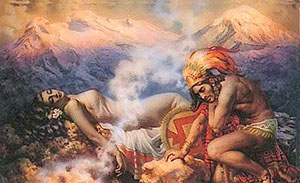 |
|
Iztaccihuatl and prince
Popocatepetl - Artist Jesus Helguera | |
The story continues with Popocatepetl setting off for
battle with Iztaccihuatl waiting for her beloved's
return. Treacherously, a rival of Popocatepetl's
sends a false message back to the ruler that the
warrior has been slain when in fact, Popocatepetl has
won the battle and is ready to return to his
Iztaccihuatl. However, the princess upon hearing the
false news, falls ill and succumbs to her deep sorrow,
dying of a broken heart. When Popocatepetl returns
triumphant to his people only to encounter his
beloved's death, his heartbreak is inconsolable.
He carries Iztaccihuatl's body to the mountains
whereupon he has a funeral pyre built for both himself
and his princess. Grief-stricken beyond measure,
Popocatepetl dies next to his beloved. The Gods,
touched by the lover's plight, turn the humans into
mountains, so that they may finally be together. They
remain so to this day with Popocatepetl residing over
his princess Iztaccihuatl, while she lay asleep. On
occasion, Popo will spew ash, reminding those watching
that he is always in attendance, that he will never
leave the side of his beloved Izta.
|